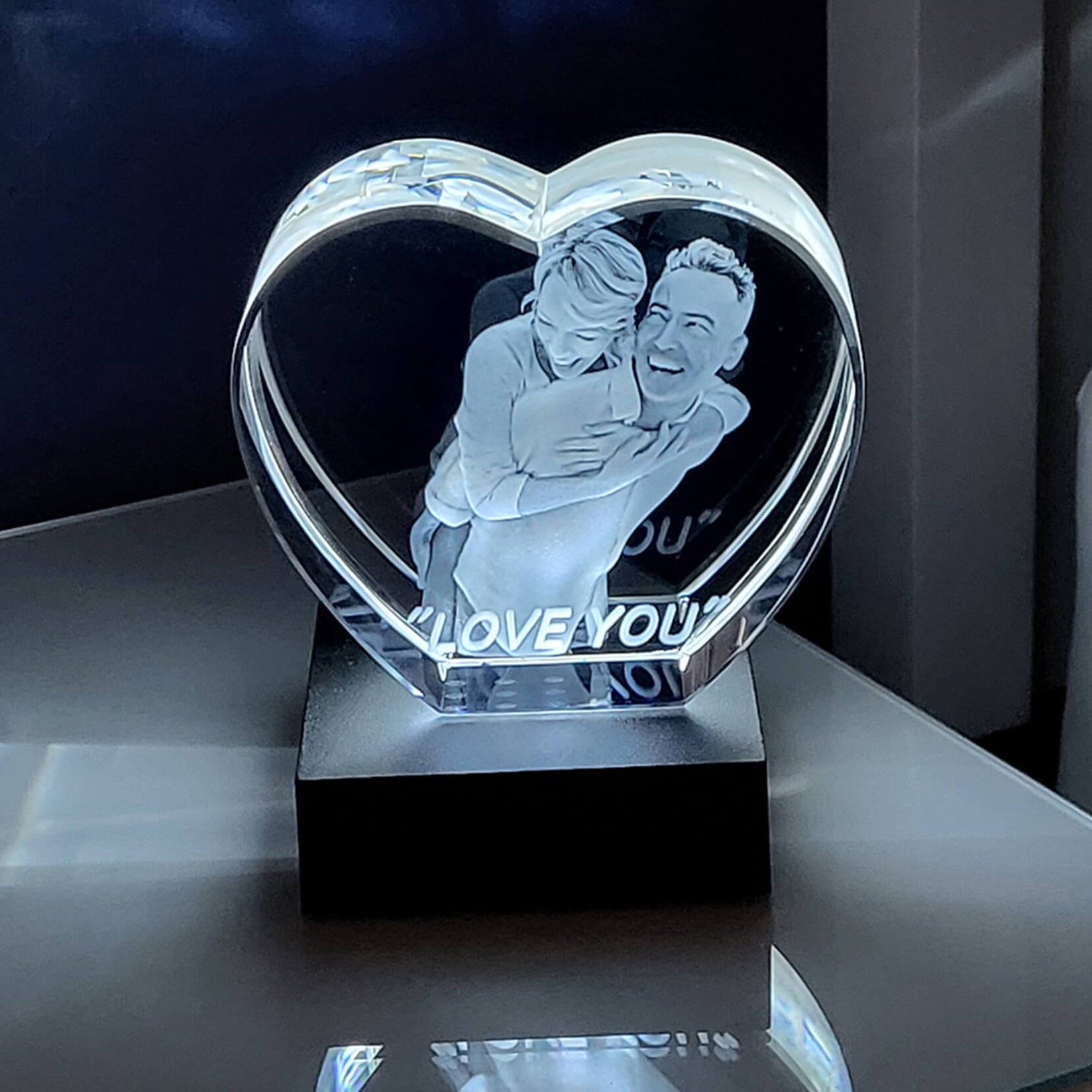
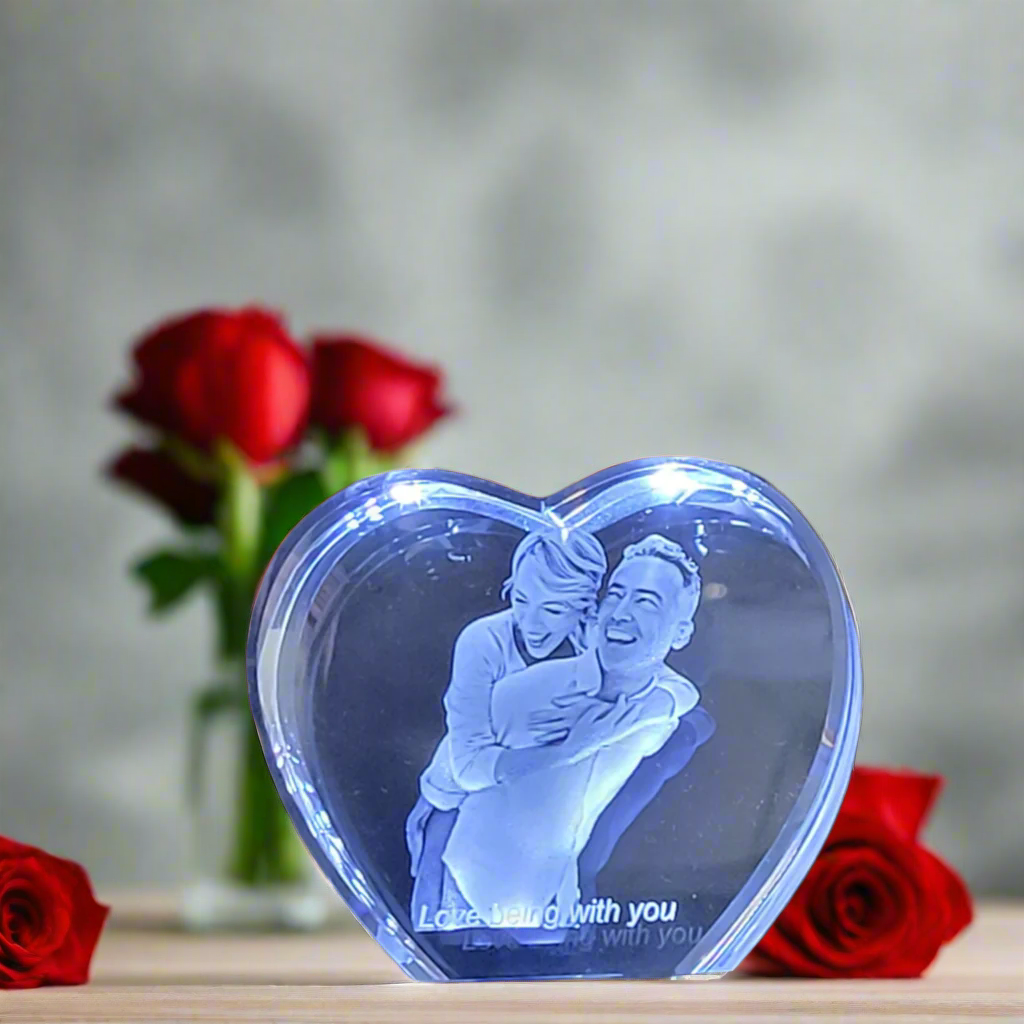
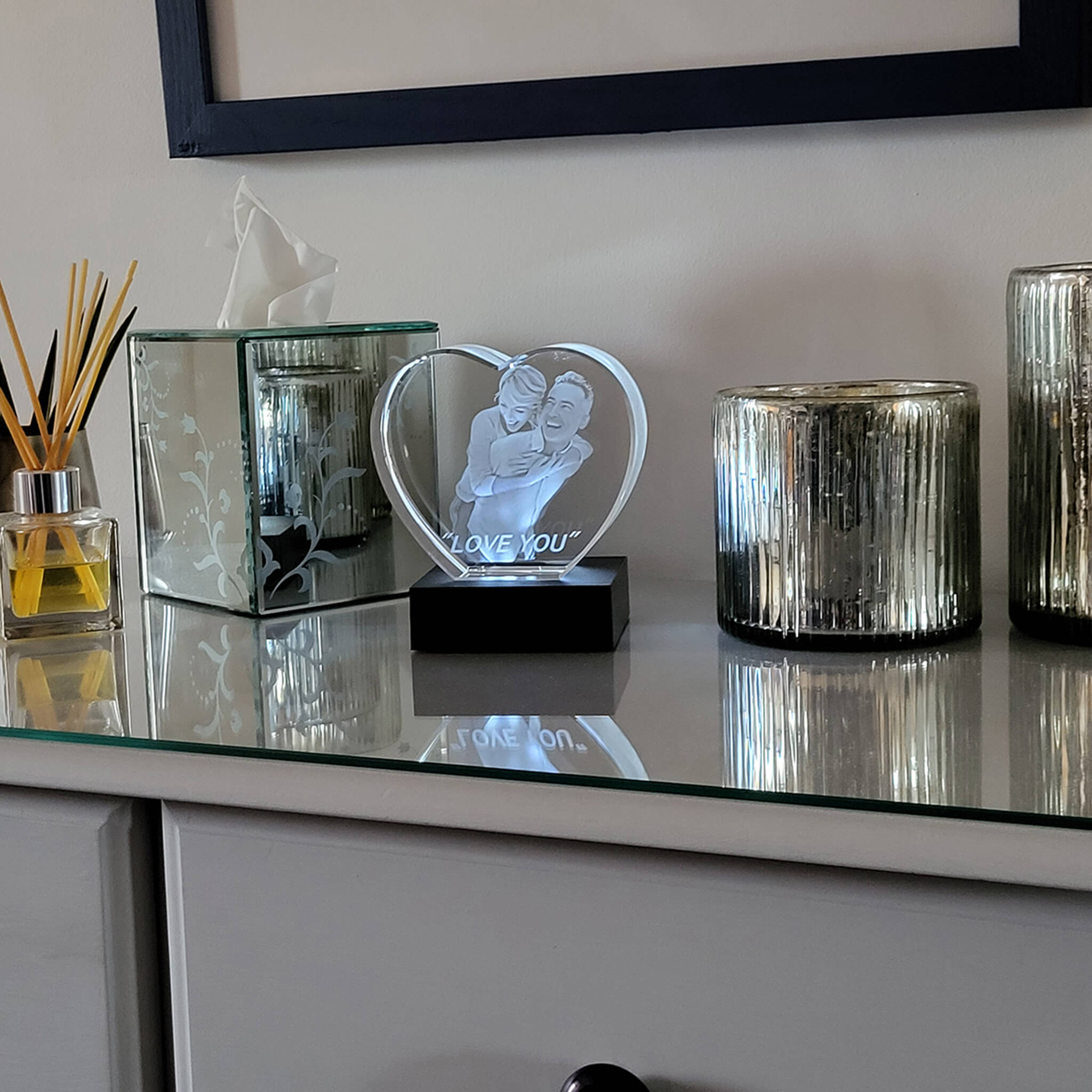
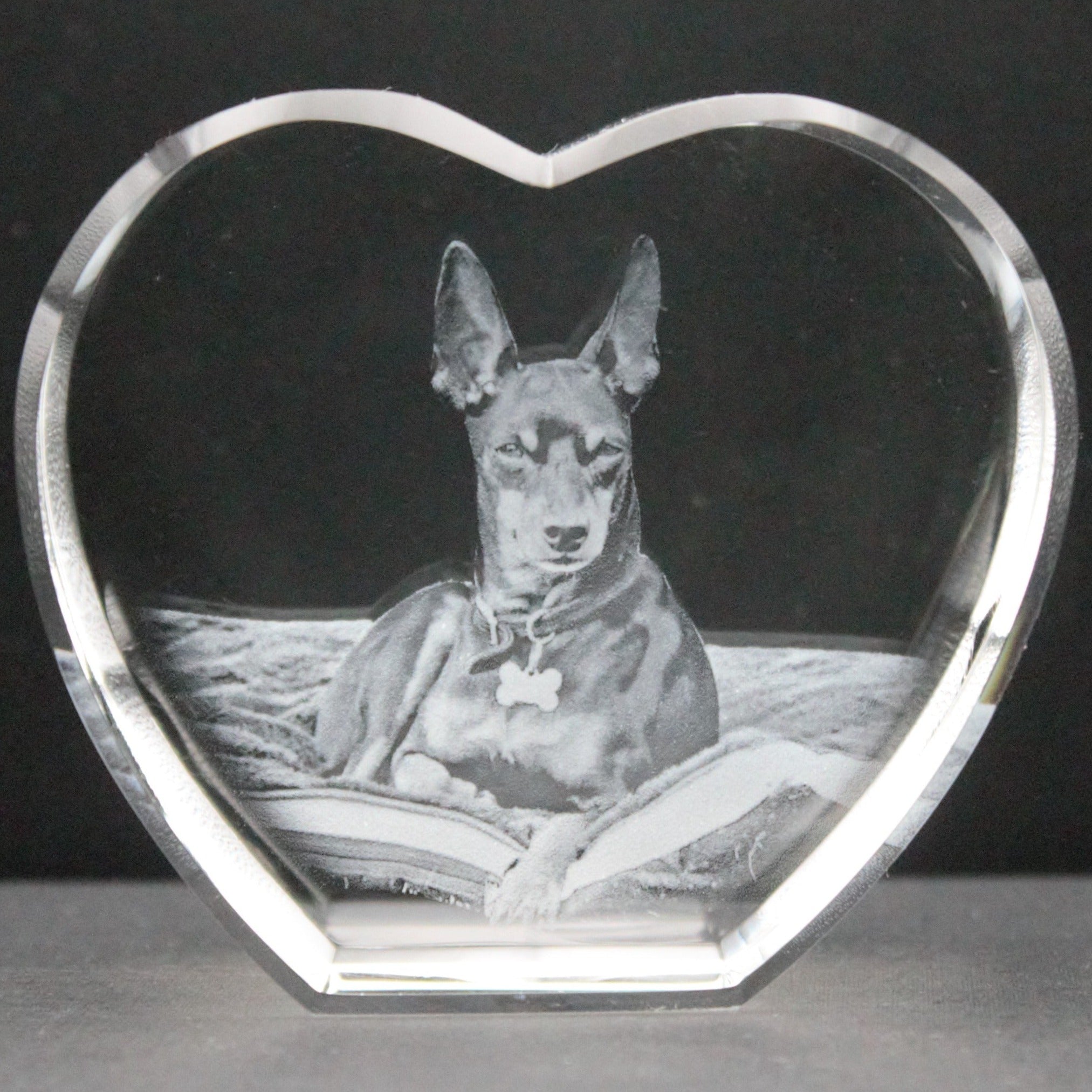
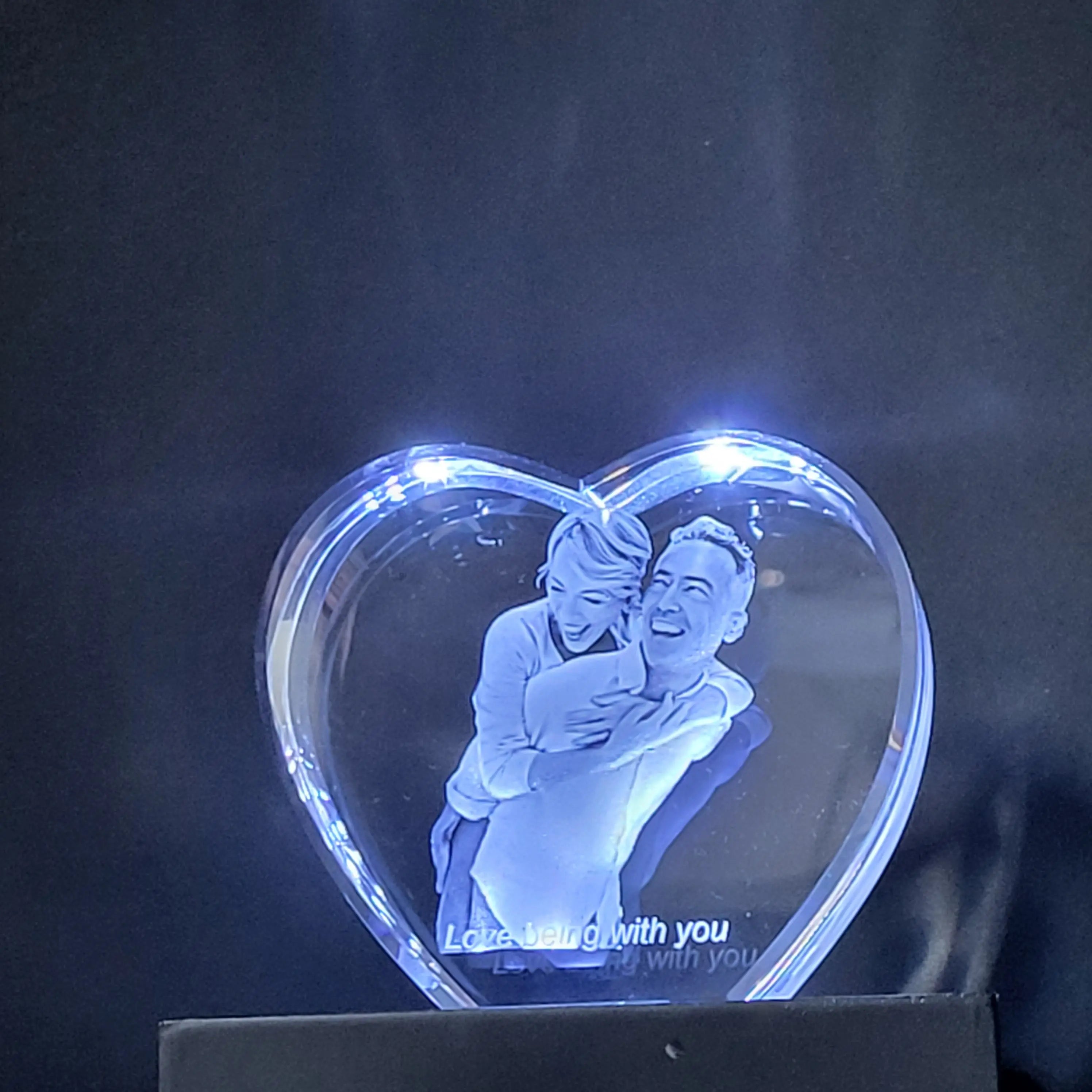
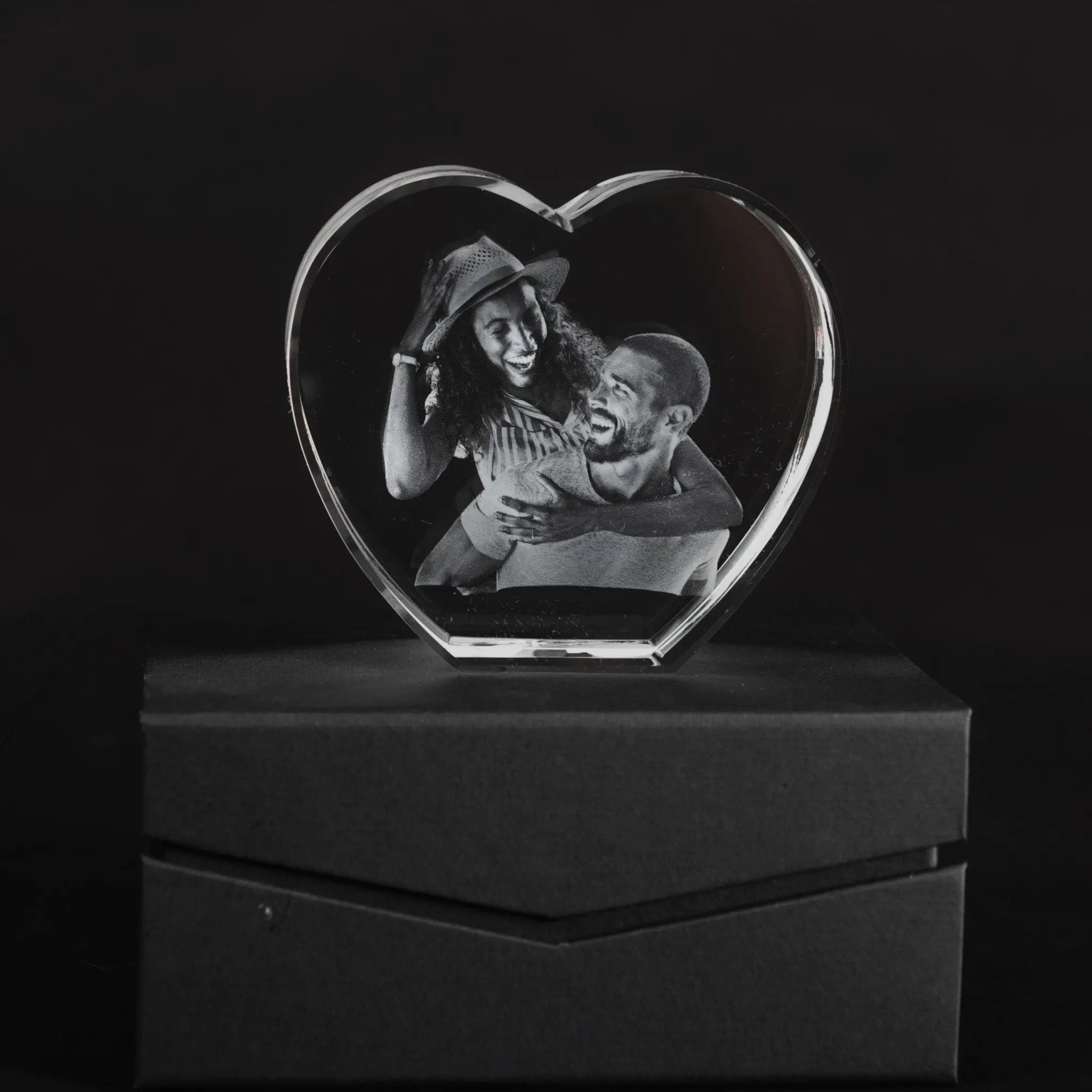
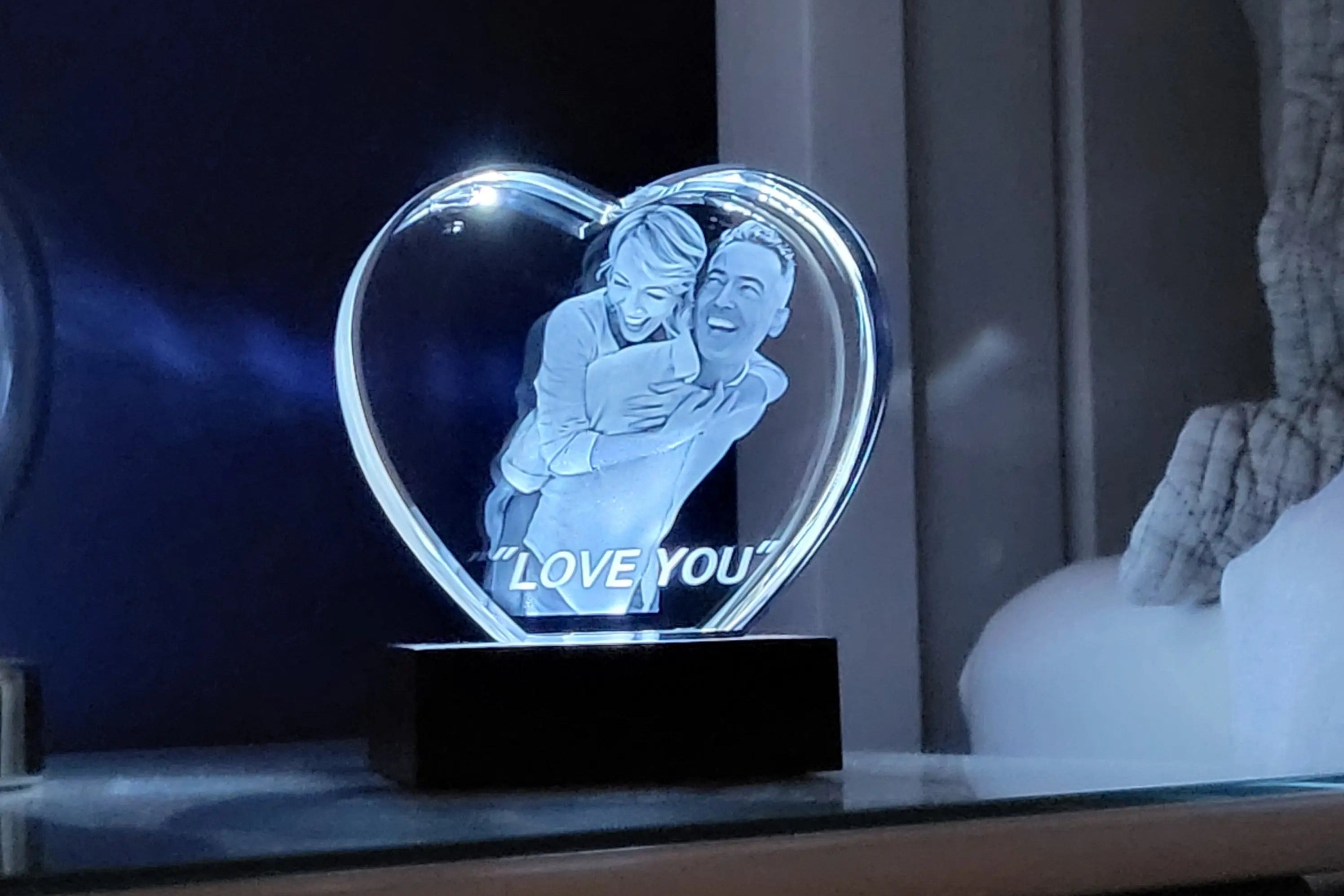
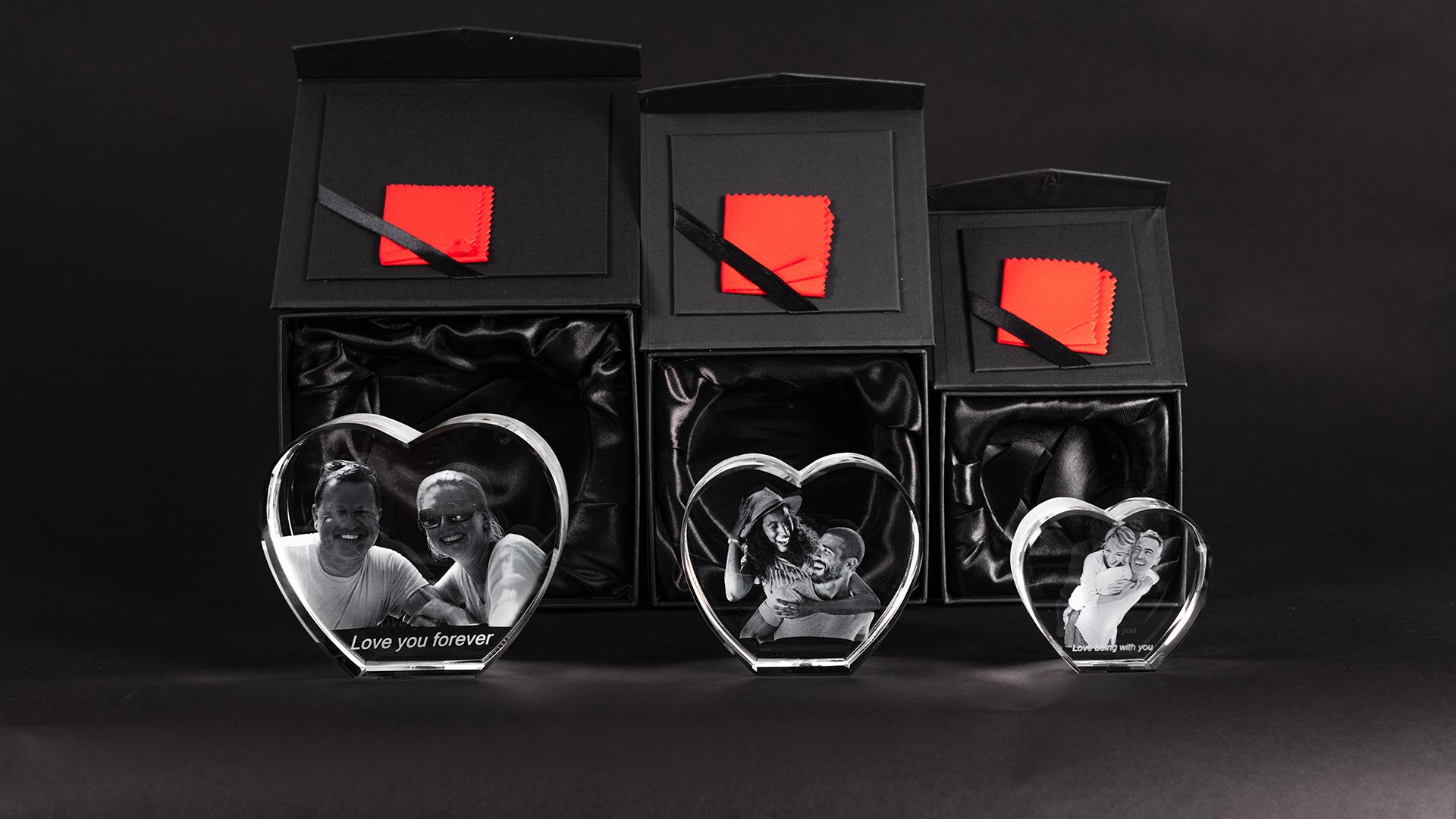
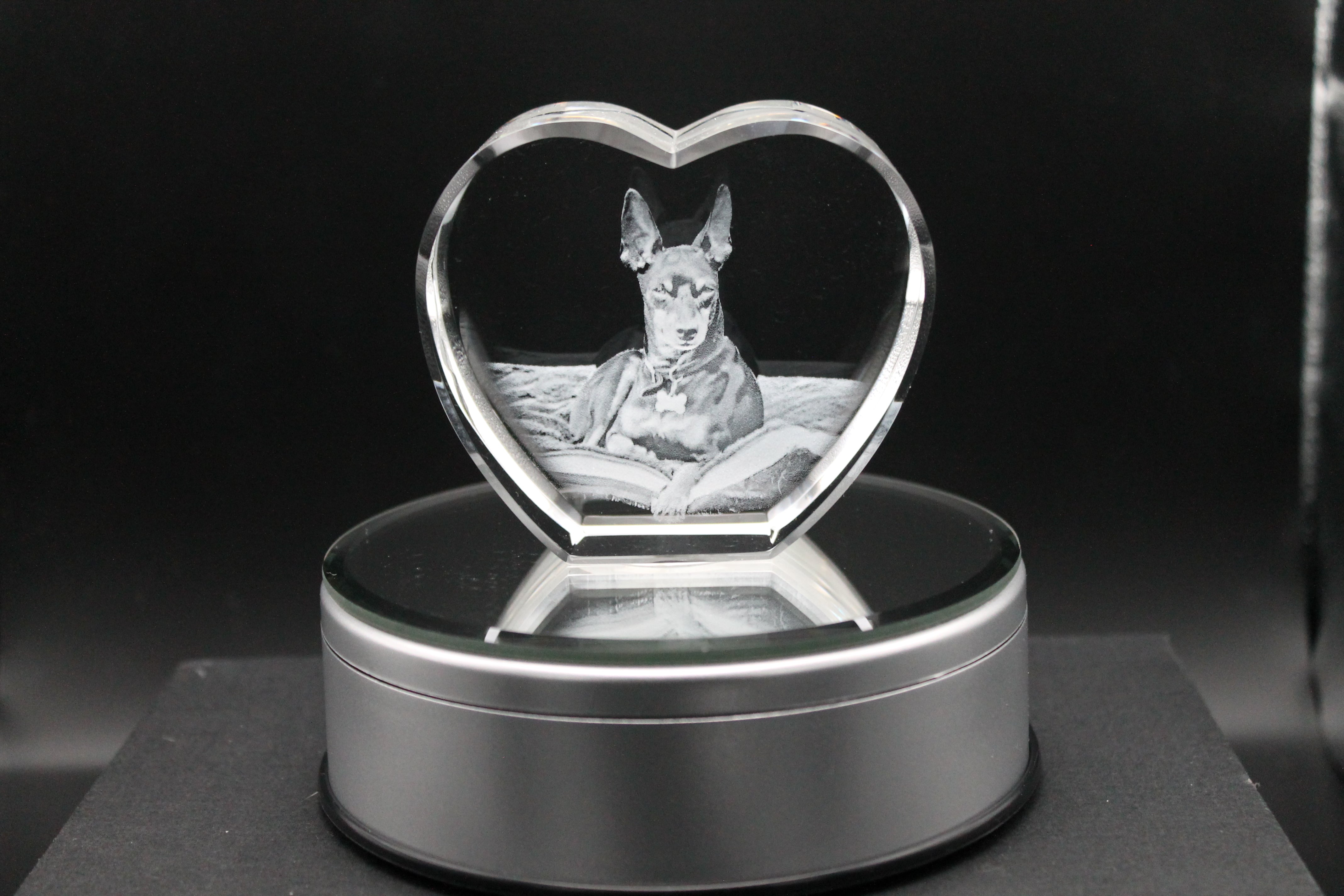
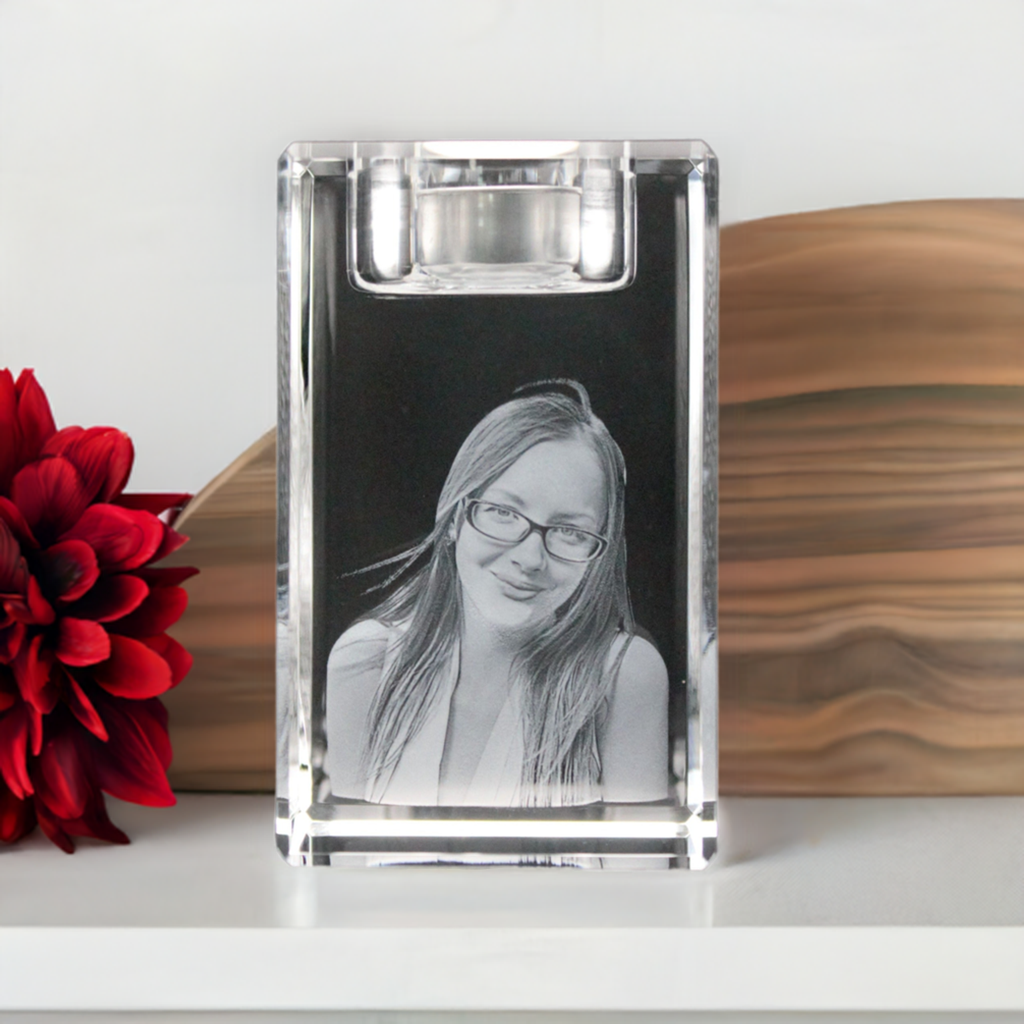
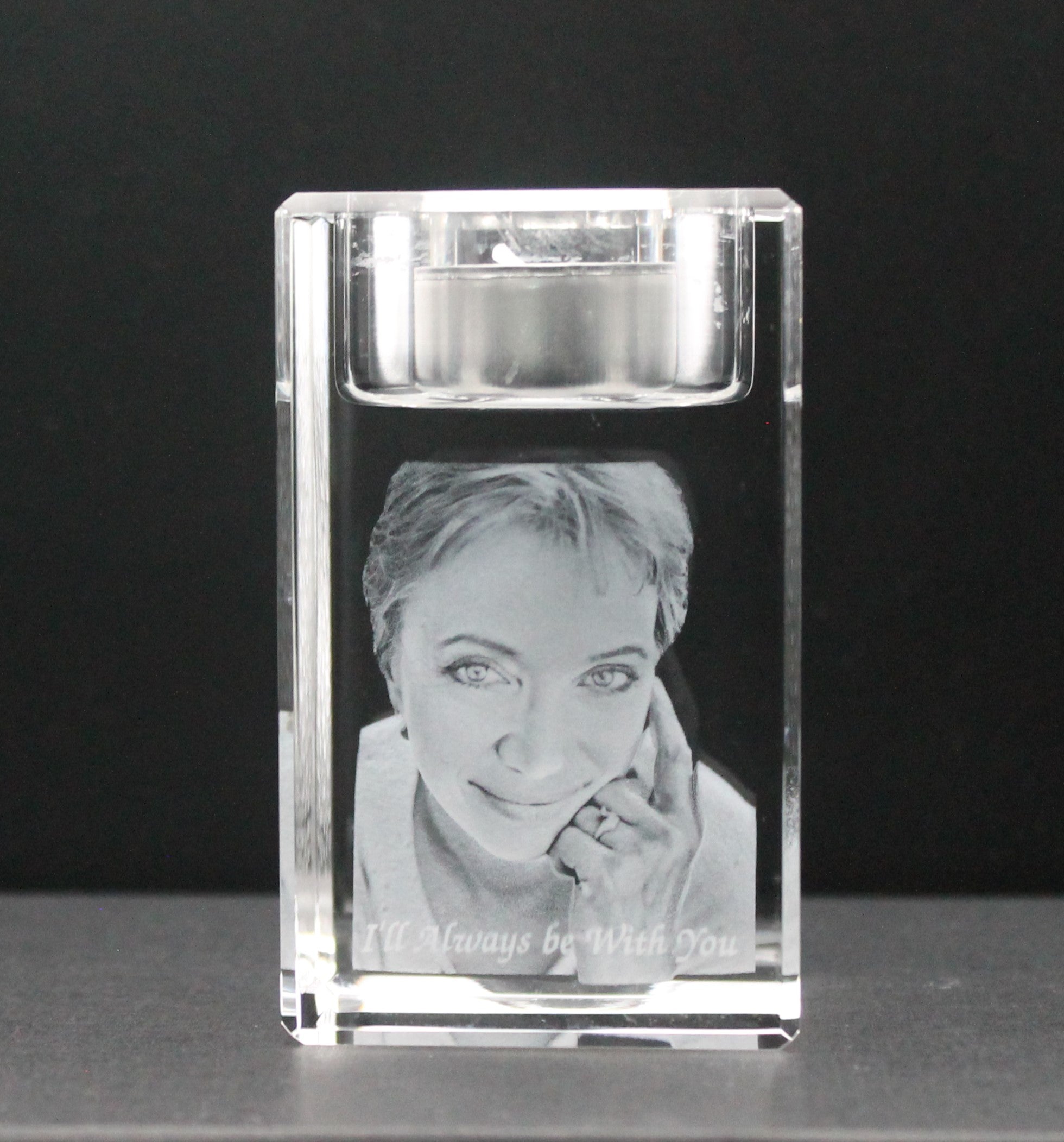
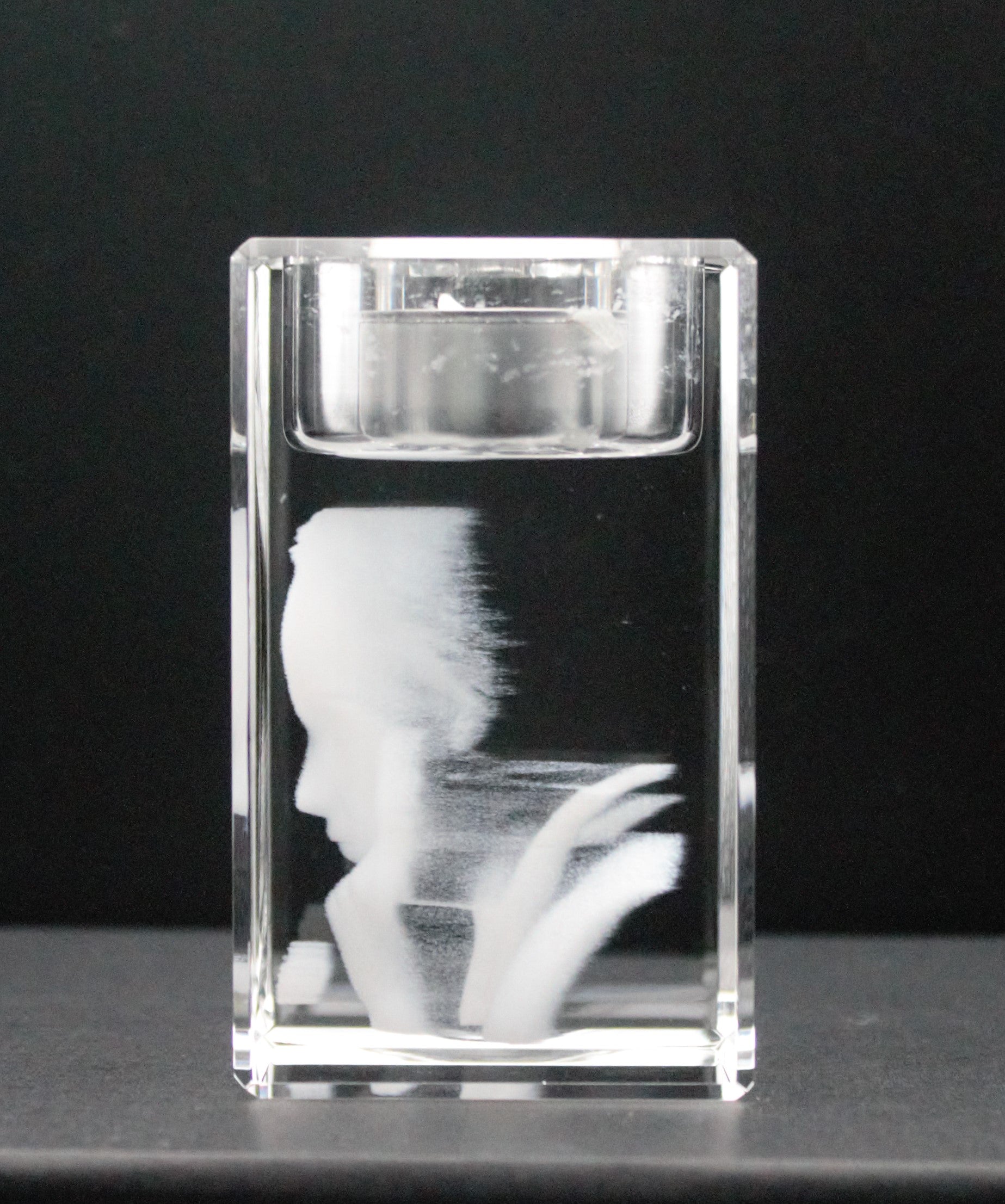
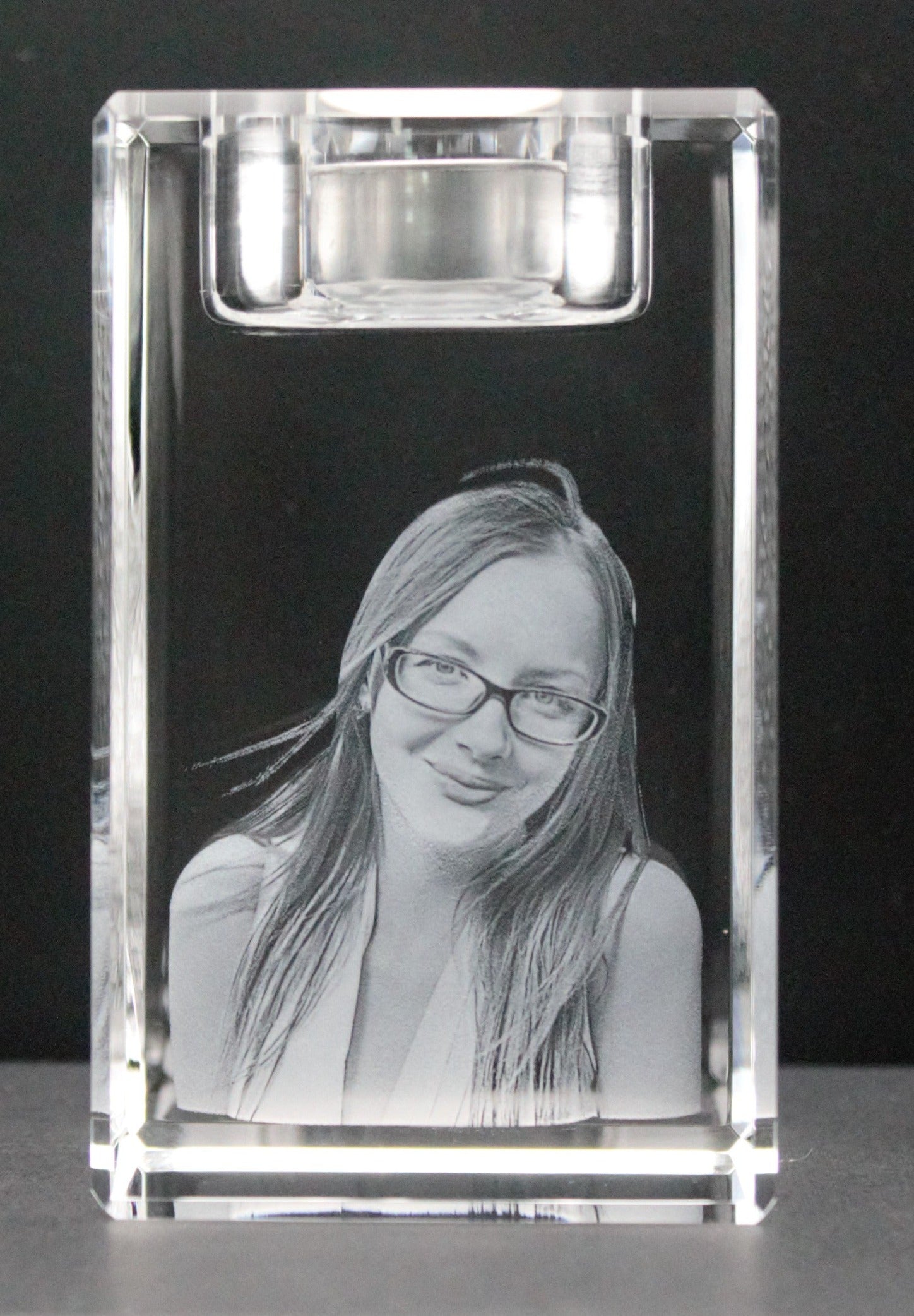
A laser is focused to a single point inside the glass. At that point, and only at that point, the energy is high enough to fracture the glass and leave a tiny white dot. The beam travels through the surface without marking it. Do that a few million times, in three dimensions, and the dots become a photograph floating in the middle of a solid block.
That is the whole answer. The rest of this explains it properly, because it is the question we get asked more than any other and most of the answers online are wrong.
We run the machines. We have engraved over 15,000 crystals in four years from our workshop in Cambridgeshire, so this is written from the shop floor rather than from a brochure. If you would rather skip the explanation and see the finished thing, here is the full range of 3D photo crystals.
The proper name for it
It is called sub-surface laser engraving. You will also see it called laser-etched crystal, 3D crystal engraving, or bubblegram — the last of those is an old name from when the dots were coarser and looked like bubbles.
What it is not is printing, etching or sandblasting. Those all happen on the outside.
Why the outside stays perfectly smooth
This is the part that surprises people, and it is simple optics.
A lens concentrates the laser beam down to a focal point. Along the way — including as it passes through the outer face of the glass — the energy is spread across a wide enough area to do nothing at all. At the focal point it is concentrated into a spot a few microns across, and the energy density there is enough to break the glass internally.
The result is a microscopic fracture, roughly the width of a human hair, that scatters light and therefore looks white. Nothing has been removed. Nothing has been added. Run a fingernail across a finished crystal and you feel glass.
Because the mark is inside, there is nothing to rub off, catch dirt, scratch or fade. That is the practical reason people choose it over anything printed, and it is why a 3D crystal photo cannot fade the way a print does.
How a photograph becomes millions of dots
Four stages, and the laser is the quickest of them.
1. The photo is separated from its background. The subject is cut away from whatever is behind it, because a background engraved as a solid mass of dots turns the whole crystal cloudy. We do this by hand on every order.
2. It is converted into a depth model. Software builds a three-dimensional point cloud — essentially a decision about where in the depth of the crystal every dot should sit. Faces come forward, shoulders fall back. This is what makes it three-dimensional rather than a flat image suspended in glass.
3. The point cloud is spaced. Dots too close together crack the glass; too far apart and the image is faint. A large crystal can carry up to 15 million points.
4. The laser plots them. The head moves in X and Y, the focal depth moves in Z, and the machine fires a pulse at each coordinate, working through the block layer by layer. A keyring takes a few minutes. A large rectangle with a detailed group photo can take half an hour.
The photograph you send matters more to the finished result than any of this — there is a short guide to choosing the right photo.
What glass can actually take it
Not much of it, is the honest answer.
The glass has to be optically clear, free of bubbles, and free of internal stress. Any impurity scatters the beam, which at best blurs the image and at worst cracks the block — sometimes days later.
The industry standard is K9 optical crystal, the same family of glass used for camera lenses. Ordinary window glass, bottle glass and most decorative glassware will not take a clean sub-surface engraving. This is why you cannot bring in a glass vase and have a photo put inside it.
Inside engraving versus surface engraving
| Inside (sub-surface) | Surface (etched or sandblasted) | |
|---|---|---|
| Can you feel it? | No | Yes |
| Can it wear or scratch off? | No | Yes |
| Photographs | Full 3D, millions of points | Flat, coarse |
| Suitable glass | Optical crystal only | Almost any glass |
| Typical UK cost | From £39.99 | A few pounds |
Neither is better in the abstract. If you want a name on a pint glass, surface engraving is the sensible choice. If you want a photograph that will still look identical in thirty years, it has to be inside.
What it costs
For sub-surface photo engraving in the UK, our own prices are: keyrings and necklaces from £39.99, cubes from £40, rectangles from £59.99, hearts from £69.99. Every price includes converting the photo to 3D, engraved text, background removal and free UK delivery. There is a fuller breakdown in how much do 3D crystal photos cost in the UK?
What drives the price is the size of the block and the number of points in it, not the complexity of the picture. A simple photo in a large crystal costs more than a busy one in a small crystal.
Can you do it at home?
No, and it is worth being straight about why, because a lot of pages online imply otherwise.
A hobby laser cutter or diode engraver has no focal control in the vertical axis — it marks whatever surface it is pointed at. Sub-surface work needs a pulsed laser and a positioning system accurate to a few microns in three axes, plus software to build the point model. It is a different machine doing a different job.
What you can do at home is take a good photograph, which matters far more to the finished result than most people expect.
Questions we get asked
How do they engrave inside glass?
A pulsed laser is focused to a single point inside the glass. Only at that focal point is the energy high enough to fracture the glass, creating a microscopic white dot roughly the width of a human hair. The beam passes through the surface without marking it. Millions of those dots, plotted in three dimensions, form the image. The process is called sub-surface laser engraving.
Why does the outside of the glass stay smooth?
Because the laser energy is only concentrated enough to break the glass at the exact point it is focused on. Everywhere else, including at the surface, the beam is spread across a wider area and passes straight through. You can run a fingernail across a finished crystal and feel nothing.
Can you engrave inside glass at home?
Not realistically. Sub-surface engraving needs a pulsed laser with precise focal control and a machine that positions the focal point to within a few microns in three axes. Hobby laser cutters and rotary tools mark the surface only. They are two different processes.
What is the difference between engraving inside glass and engraving the surface?
Surface engraving abrades or etches the outside, so it can be felt, can collect dirt and can be scratched or worn away. Inside engraving sits within the glass and cannot be touched at all, which is why it does not fade, peel or wear.
How much does glass engraving cost in the UK?
Surface engraving on a bought glass item is usually a few pounds. Sub-surface photo engraving inside optical crystal starts at £39.99 for a keyring, £40 for a cube, £59.99 for a rectangle and £69.99 for a heart, including converting the photo to 3D, engraved text, background removal and free UK delivery.
What kind of glass can be engraved inside?
Optically clear glass with no bubbles, tint or internal stress. K9 optical crystal is the standard because ordinary window or bottle glass contains impurities that scatter the beam and can crack under it.
How long does it take to engrave inside glass?
The engraving itself takes a few minutes for a small crystal and up to around half an hour for a large one with a detailed image. Preparing the photograph and building the 3D point model takes longer than the laser does.
If you want one made
We do this every working day. There is more on our own end-to-end process on how 3D crystal photos are made, the range is in all 3D photo crystals, and if you tick the preview box when you order it is free, emailed within 24 hours, and nothing is engraved until you are happy with it.
Send us the photo and we will tell you honestly what we can do with it — get in touch.
Sarah & Shaun
Related reading
Which 3D crystal shape should I choose? · How much do 3D crystal photos cost in the UK? · Can 3D crystal photos fade? · Which company makes the best 3D crystal photo gifts in the UK? · Choosing a memorial crystal · Crystal anniversary gifts